
Flame-free and smoke-free altar planner
A practical way to plan a small altar without candles, incense or smoke. Start with the space you actually have, use what you already own, and leave room to put it all away.
An altar might hold spiritual meaning, mark a season, or give you a place for reflection. The choices below are optional examples, not rules for every tradition. You do not need a flame, fragrance, crystals or a shopping list to try them.
This planner complements our altar setup guide. Rather than covering the basics again, it helps you measure a working space, choose a few suitable objects and plan a tidy finish.
Download the four-page altar planner (PDF). It includes a planning sheet, two original illustrated examples, a blank layout grid and a reusable checklist. Print all four pages or just pages 3 and 4 for a fresh plan. The fields are for handwriting; the grid is not a physical measuring template.
1. Decide what you are leaving out
Write your boundaries before choosing any objects. For this planner, leave out lit candles, incense, charcoal, matches, lighters and anything else that burns or smoulders. Check the rules of your home, accommodation or shared space too.
Smoke-free does not automatically mean fragrance-free. If you also want no scent, use unscented paper, a notebook and simple imagery. There is no need to substitute oils, sprays, diffusers or wax warmers.
Choose one purpose for this version of your altar, such as:
- A place to write one intention and return to it later.
- A seasonal display made from your own drawings or photographs.
- A space to reflect on someone or something important to you.
- An arrangement that supports your own spiritual practice, within its traditions and your household boundaries.
Then complete this sentence: “For this space to work in my home, it needs to…” Your answer might be “fit in a drawer after use”, “leave the desk free for work”, or “contain no loose small objects”.
2. Measure the usable space, not just the furniture
Use a ruler or tape measure to record the width and depth you can actually use. A desktop may be wide, but the space needed for a keyboard, elbows, a door opening or everyday tasks is not spare altar space.
Choose a stable, level surface that can support the objects. Keep routes, vents, sockets and switches unobstructed, and keep the arrangement away from heat sources. Do not balance objects on the edge or let a tray overhang. Check that you can reach everything comfortably without leaning across other objects.
On the printable grid, draw the usable outline first. Mark anything that must remain clear. Then measure each object’s footprint, including a journal when open, not only when closed. Leave working room and reduce the number of objects if the space feels crowded.
The example measurements below only show how a layout can be planned. They are not minimum sizes, safety clearances or a recommendation for every home.
3. Give each object a job
Use three simple roles to avoid buying things just to fill a gap:
- Focus: a word, drawing, photograph or symbol that means something to you.
- Activity: a notebook, a single card to reflect on, or an empty area for the practice you have chosen.
- Finish: a folder, drawer or box where the items will go afterwards.
One object may do more than one job. A notebook can contain both a seasonal drawing and your reflection. A sheet of paper can be the whole arrangement.
If you use elemental symbolism, a drawn flame can represent fire and a drawn wave can represent water. These are personal or tradition-based symbolic choices, not claims that paper has physical or healing properties. You can also omit elemental symbolism entirely. A written dedication can take the place of a physical offering if that fits your practice.
For a low-cost first attempt, use paper and a notebook you already have. Skip loose crystal chips, beads, coins, seeds, magnets and other small decorative pieces where children or pets could reach them. Paper-only does not mean risk-free: keep the arrangement and its storage appropriate to the people and animals in your home.
4. Try one of two worked layouts
Both examples are top-down plans. The outlines show a chosen planning footprint, not a new piece of furniture you need to buy. The printed diagrams are illustrative, not full-size templates.
Layout A: a desk space that returns to work
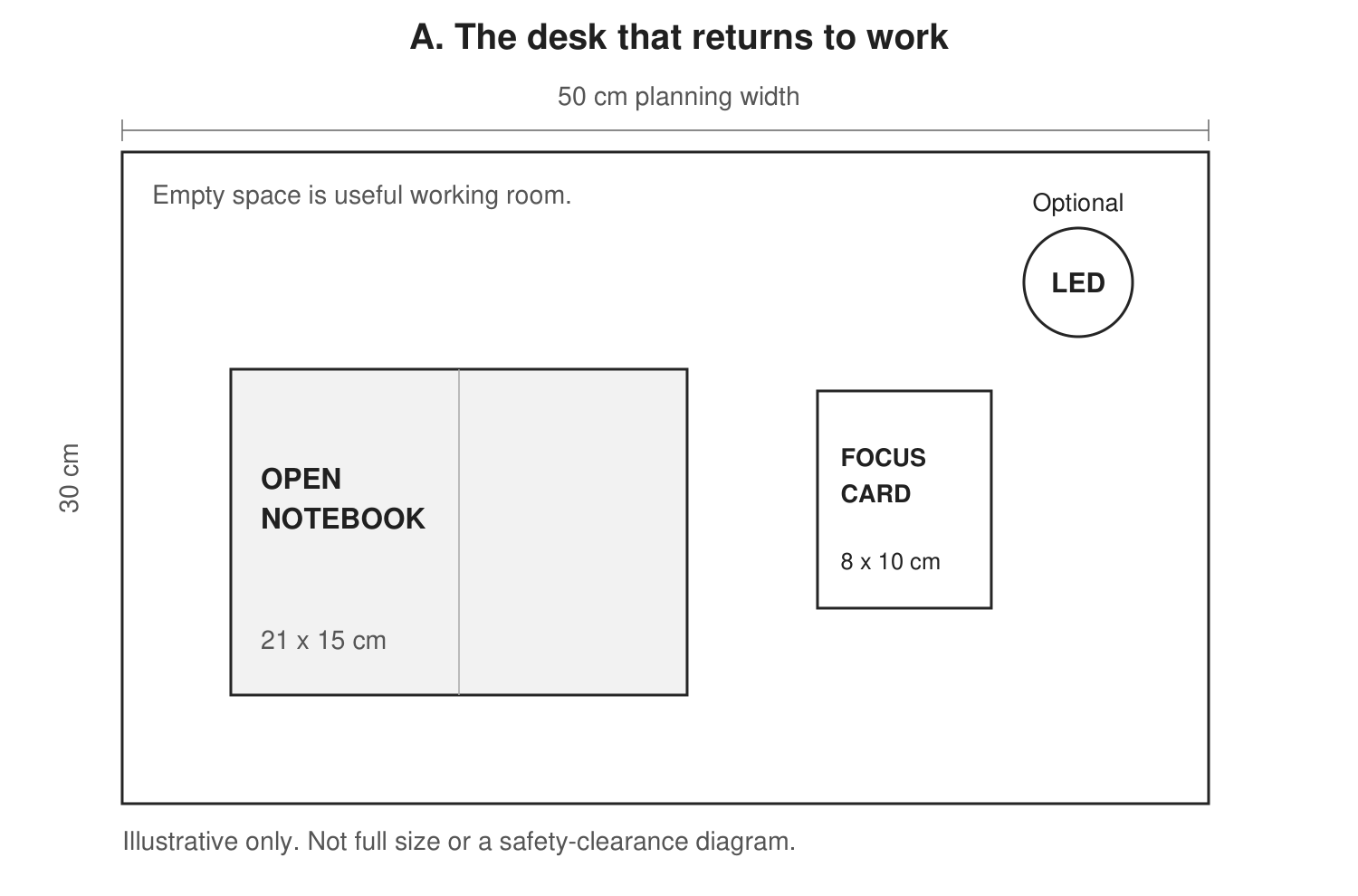
- Chosen planning area: 50 cm wide by 30 cm deep on an existing stable desk.
- Open notebook: 21 by 15 cm, placed where writing feels comfortable.
- Flat focus card: 8 by 10 cm, placed beside the notebook.
- Optional light: an illustrated 5 cm circular LED footprint. Measure your actual light and follow its instructions; this is not a recommended product size or clearance.
Try the plan without the light first. Open the notebook fully and sit where you will use it. If your arm catches a card, or something is awkward to reach, move it or leave it out. The remaining blank space is useful working room, not a gap to decorate. Afterwards, return the paper and notebook to their usual storage and restore the desk.
Layout B: a paper-only arrangement that packs away
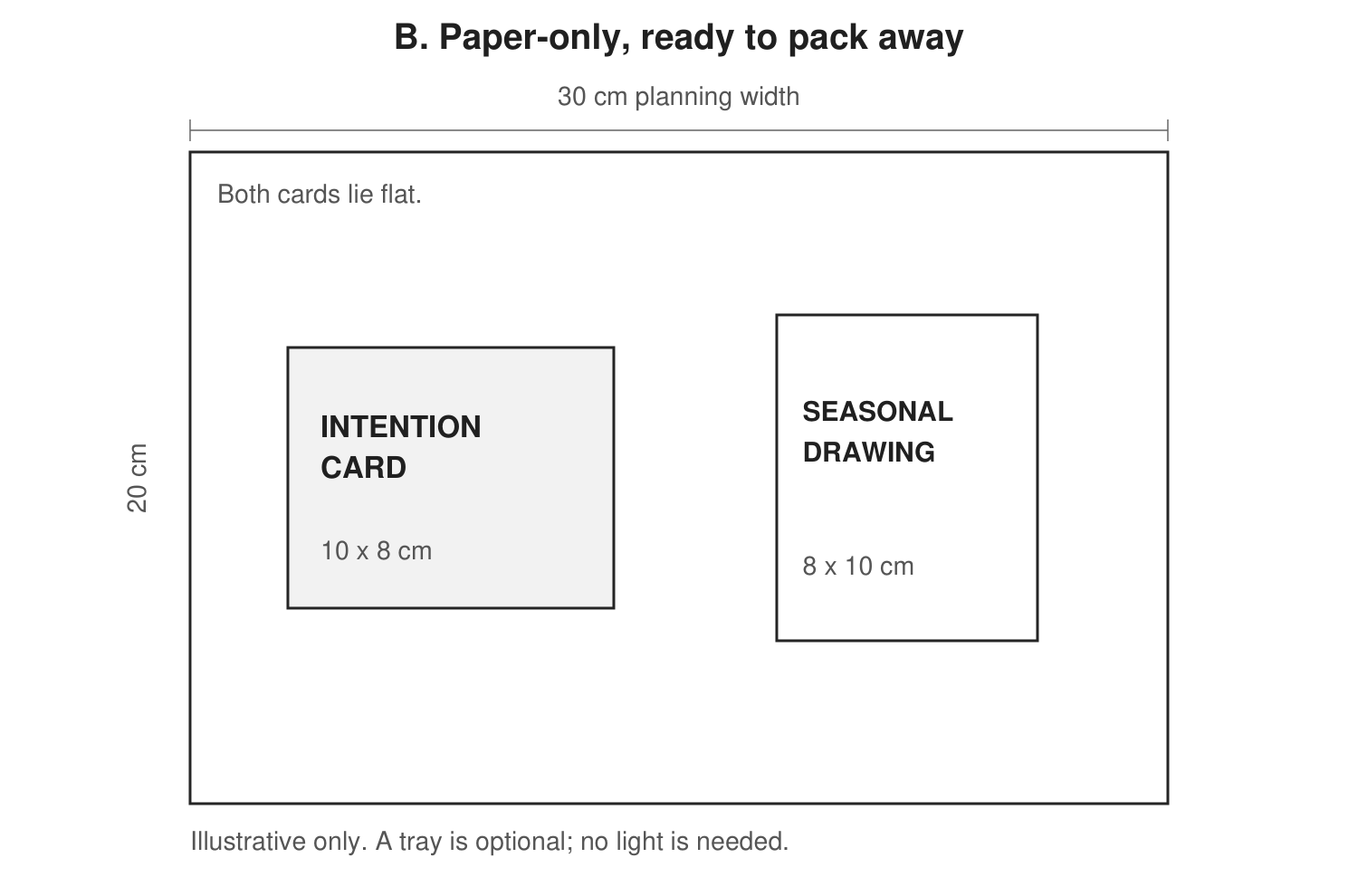
- Chosen planning area: 30 cm wide by 20 cm deep on a stable surface.
- Intention card: 10 by 8 cm, laid flat.
- Seasonal drawing: 8 by 10 cm, also laid flat.
- Storage: a folder kept in a suitable place after use.
A tray is optional. If you use one, it must fit fully on the supporting surface and sit steadily. Put the cards away before moving or storing it. You can redraw the seasonal card rather than add natural materials, small decorations or fragrances. This example has no electrical items or liquid containers, so there is less to set up and put away, but it still needs household-specific checks.
5. If you choose an LED light, check the whole product
An LED removes the open flame from the arrangement; it does not make the arrangement fireproof or universally safe. Follow the manufacturer’s instructions for placement, batteries and use. Check the light and any remote control for damage and ensure battery compartments close securely. Do not use a damaged item or one with an insecure compartment.
Some flameless candles and remotes contain button or coin batteries. These can seriously injure children or pets if swallowed. Keep products and batteries inaccessible to them; a high surface alone may not prevent access. Store spare and used batteries securely and recycle used batteries promptly, rather than putting them in household rubbish. See the Office for Product Safety and Standards’ button battery guidance and RoSPA’s button battery advice.
If you think a child has swallowed a button battery, go straight to A&E or call an ambulance. Do not wait for symptoms. Suspected battery ingestion by a pet needs urgent veterinary advice. These checks are reasons to choose a paper symbol instead if a light does not suit your home.
6. Plan the finish before you begin
Choose a storage location and a short reset routine:
- Switch off any optional light and follow its storage instructions.
- Put every item back in its agreed place, including remote controls.
- Check the surface and floor for loose items or dropped batteries.
- Restore the shared space, leaving access routes and everyday equipment clear.
- Note one thing to change next time: more writing space, fewer objects, a different storage spot, or no light.
Use the last page of the PDF as a repeatable checklist. If you cannot keep an arrangement secure between uses, choose a temporary version and put it away fully.
For the broader starting points, our beginner witch guide covers tools, intentions and everyday practice. This planner is deliberately narrower: a few meaningful choices that fit your actual space, with no compulsory purchase.
Safety sources and scope
Safety references checked on 20 October 2026:
- Office for Product Safety and Standards: new button battery safety posters, including secure storage, recycling and urgent action after suspected ingestion.
- Office for Product Safety and Standards: using button and coin batteries, including risks to children and pets.
- RoSPA: button batteries, including flameless candles and remote controls.
- RoSPA: decoration and light safety, including following instructions, checking for damage and avoiding heat sources and trip hazards.
- PDSA: first aid for poisons and toxins, including prompt veterinary contact after suspected poisoning.
The layouts and worksheets are original planning examples, not safety certification or a substitute for product instructions. Spiritual meanings are presented as optional beliefs or personal symbolism, not established physical effects.