Niffty Library · Belief, history & mythology
Gods & Deities Guide
Meet the deities behind the stories. Explore their histories, symbols and cultural worlds through an illustrated guide to ancient and living traditions.
From Hecate’s torches and Odin’s ravens to Isis, Brigid and Ganesha, a familiar name is only the beginning. Each profile looks beyond a simple “god of” label to the stories, places and people that give it meaning.
01 / Greek deities and their Roman connections
Greek deities and their Roman connections
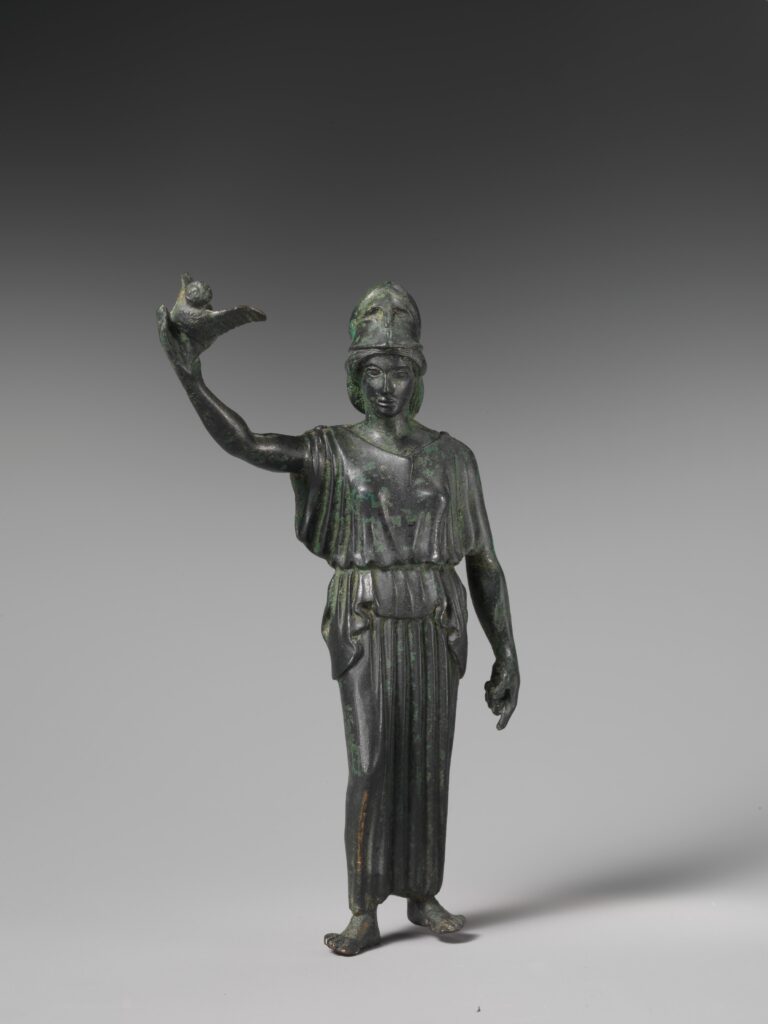
Greek religious life included many gods, local cults and differing versions of the same myth. These selected profiles focus on Greek sources and give commonly linked Roman names as a starting point. Roman deities had their own histories, temples and public roles; a familiar pairing does not make two traditions identical. Symbols are clues to historical art and narrative, rather than a universal list of magical correspondences.
Jump to a profile: Zeus · Hera · Poseidon · Demeter · Athena · Apollo · Artemis · Aphrodite · Ares · Hephaestus · Hermes · Dionysus · Hestia · Hades · Persephone · Hecate (Hekate)
Zeus
Greek • sky and sovereignty • Roman counterpart: Jupiter
Zeus rules the Olympian gods in Greek myth and presides over the sky, storms and the responsibilities of authority. His concerns also include oaths, hospitality and the protection of people seeking refuge. Ancient artists usually show a mature, bearded ruler carrying a thunderbolt or sceptre, often accompanied by an eagle.
In Hesiod’s Theogony, Zeus survives his father Cronus’s attempt to swallow his children and eventually leads the struggle against the Titans. This makes his kingship the outcome of a contested succession. Jupiter was closely identified with Zeus in Roman culture, but Roman worship had its own institutions and history.
In art and tradition: Thunderbolt; Eagle; Sceptre; Oak
Worth knowing: His protection of guests and sworn promises is as important as his power over storms.
Read more: Theoi: Zeus, ancient text excerpts and iconography · Hesiod, Theogony, translated by H. G. Evelyn-White (1914), via Theoi
Hera
Greek • marriage and divine queenship • Roman counterpart: Juno
Hera is queen of the Olympian gods and a major Greek goddess of marriage. A crown, veil and sceptre express her dignity in ancient art; the peacock became another familiar association. Her worship was especially prominent at sanctuaries such as Argos and Samos, showing a religious importance that extends beyond stories about her marriage to Zeus.
Myths frequently portray her anger at Zeus’s affairs, but they also show her supporting heroes. She helps Jason and the Argonauts, for example. Reading her solely as a jealous wife misses the authority, civic presence and concern with marriage that shaped her ancient cults.
In art and tradition: Crown or diadem; Sceptre; Veil; Peacock
Worth knowing: Hera’s ancient worship was wider and more prestigious than her jealous-wife stereotype suggests.
Read more: Theoi: Hera, ancient text excerpts and iconography · The Metropolitan Museum of Art: Greek Gods and Religious Practices
Poseidon
Greek • sea, earthquakes and horses • Roman counterpart: Neptune
Poseidon governs the sea in Greek tradition, but his powers also reach beneath the earth: he is the Earth-shaker associated with earthquakes. Horses belong to his sphere too. His clearest visual attribute is the three-pronged trident, while ancient art often gives him a beard, marine companions or a chariot.
In the Odyssey, his hostility towards Odysseus follows the blinding of his son, the Cyclops Polyphemus. The story captures the sea’s danger and the consequences of offending a powerful god. Poseidon could also be petitioned for safety, so his cult cannot be reduced to anger or destruction.
In art and tradition: Trident; Horses; Dolphins; Marine chariot
Worth knowing: His ancient roles include horses and earthquakes as well as the sea.
Read more: Theoi: Poseidon, ancient text excerpts and iconography
Demeter
Greek • grain and cultivation • Roman counterpart: Ceres
Demeter is a Greek goddess of grain, cultivated land and the food on which human communities depend. Ears of wheat, torches and a sheaf of grain are helpful ways to recognise her. She is closely connected with her daughter Persephone and with the religious mysteries celebrated at Eleusis.
The Homeric Hymn to Demeter describes her search after Hades abducts Persephone. In grief and anger, Demeter withholds growth until an agreement allows their reunion. The narrative connects agriculture with divine power, loss and restoration; its detail should not be flattened into a single universal explanation of the four seasons.
In art and tradition: Grain; Wheat sheaf; Torches
Worth knowing: The hymn centres maternal grief and the interruption of cultivation, not a simple seasonal chart.
Read more: Theoi: Demeter, ancient text excerpts and iconography · Homeric Hymns 1–3, translated by H. G. Evelyn-White (1914), via Theoi
Athena
Greek • wisdom, strategy and crafts • Roman counterpart: Minerva
Athena brings together practical intelligence, warfare, skilled making and the protection of cities. She is especially connected with Athens. A helmet, spear and shield identify her, often alongside an owl or the aegis, a protective garment bearing the Gorgon’s head. Weaving and other crafts also belong to her sphere.
One famous myth describes her emerging fully armed from Zeus’s head. Another links her patronage of Athens with the gift of an olive tree. These stories join resourcefulness to civic life. Calling her only a goddess of wisdom can obscure the armed, protective and artisanal aspects that ancient worshippers knew.
In art and tradition: Owl; Olive tree; Helmet and spear; Aegis
Worth knowing: Her wisdom includes skilled work and civic protection, rather than abstract knowledge alone.
Read more: Theoi: Athena, ancient text excerpts and iconography
Apollo
Greek and Roman • prophecy, music and healing
Apollo is a Greek god of prophecy, music, archery and healing, also worshipped at Rome under the same name. Laurel, a lyre, a bow and the prophetic tripod are recognisable attributes. Delphi was an important centre of his oracular worship, while Delos was celebrated as his birthplace.
His powers include the ability to send illness as well as relieve it: the Iliad opens with Apollo bringing plague to the Greek army. That tension matters when reading his myths. Although Apollo acquired strong solar associations, Helios is a distinct sun god in many early Greek sources.
In art and tradition: Lyre; Laurel; Bow; Tripod
Worth knowing: Healing and harmful power coexist in his myths; Apollo and Helios are not always interchangeable.
Read more: Theoi: Apollo, ancient text excerpts and iconography · Homeric Hymns 1–3, translated by H. G. Evelyn-White (1914), via Theoi
Artemis
Greek • hunting and wild places • Roman counterpart: Diana
Artemis is a Greek goddess of hunting, wild animals and places beyond cultivated settlement. She also watches over children and childbirth, despite remaining unmarried in the major myths. Her bow, quiver and deer are familiar visual signs, and she is often shown in clothing suited to movement.
As Apollo’s twin and Leto’s daughter, she belongs within the Olympian family while guarding an independence of her own. Stories such as Actaeon’s punishment present the danger of violating divine boundaries. Later lunar associations are important, but ancient Artemis is broader than a moon-goddess label, and her local cults differed considerably.
In art and tradition: Bow and quiver; Deer; Hunting dress
Worth knowing: Her protection of childbirth coexists with her unmarried status; local forms vary.
Read more: Theoi: Artemis, ancient text excerpts and iconography
Aphrodite
Greek • love, beauty and desire • Roman counterpart: Venus
Aphrodite is a Greek goddess of attraction, sexuality, beauty and the power of desire. Doves, apples, mirrors and shells appear among her attributes; Eros often accompanies her. Cyprus occupies an important place in her religious and mythological geography, reflected in names such as Kypris.
Ancient writers preserve different accounts of her origins. Hesiod makes her arise from the sea after the overthrow of Uranus, whereas Homer calls her a daughter of Zeus and Dione. These variations remind us that Greek myth was not one fixed text. Her influence could bring delight, attachment, rivalry and conflict alike.
In art and tradition: Dove; Apple; Mirror; Shell
Worth knowing: Her competing birth stories are ancient variants, not a mistake to reconcile into one account.
Read more: Theoi: Aphrodite, ancient text excerpts and iconography · Hesiod, Theogony, translated by H. G. Evelyn-White (1914), via Theoi
Ares
Greek • warfare and battle • Roman counterpart: Mars
Ares personifies the violence and momentum of war in Greek myth, along with the courage needed to enter battle. Artists commonly represent him as an armed warrior with helmet, spear and shield. He is a son of Zeus and Hera and has a famous relationship with Aphrodite.
The Iliad allows him to be wounded and driven from battle, emphasising that a god of war is not simply invincible. Greek responses to him range from fear to honour in particular communities. His identification with Roman Mars is useful, but Mars’s place in Roman public religion should not be inferred entirely from Ares’s literary character.
In art and tradition: Helmet; Spear; Shield
Worth knowing: Ares and Roman Mars were identified with one another without having identical cultural roles.
Read more: Theoi: Ares, ancient text excerpts and iconography
Hephaestus
Greek • metalworking and the forge • Roman counterpart: Vulcan
Hephaestus is the Greek divine craftsman, associated with fire, metalworking and the skill of making extraordinary objects. Hammer, tongs, anvil and workshop clothing distinguish him. Ancient stories describe difficulties with his legs, but also depict him as an ingenious maker whose work is indispensable to gods and heroes.
In the Iliad, he fashions Achilles’ armour, including a shield decorated with an elaborate vision of human life. Other traditions tell of mechanical helpers and self-moving objects. His profile therefore reaches beyond fire itself into artistry and invention. Accounts of his parentage and falls from Olympus differ between ancient authors.
In art and tradition: Hammer; Tongs; Anvil; Forge
Worth knowing: Ancient texts offer different accounts of his birth and disability; his craft remains central.
Read more: Theoi: Hephaestus, ancient text excerpts and iconography
Hermes
Greek • movement, messages and exchange • Roman counterpart: Mercury
Hermes is a Greek god of travellers, trade, boundaries and skilful communication. He moves between divine, human and underworld settings, serving as a messenger and guide of the dead. His herald’s staff, called the kerykeion or caduceus, is a distinctive attribute, alongside a traveller’s hat and, in many images, winged footwear.
The Homeric Hymn to Hermes introduces an astonishingly inventive infant who steals Apollo’s cattle and makes a lyre. The brothers’ eventual exchange turns conflict into a relationship. This mixture of cunning, negotiation and movement makes Hermes more complex than a straightforward patron of honesty or commerce.
In art and tradition: Herald’s staff; Traveller’s hat; Winged sandals; Lyre
Worth knowing: His cleverness can disrupt relationships and also help create new agreements.
Read more: Theoi: Hermes, ancient text excerpts and iconography
Dionysus
Greek • wine, theatre and altered states • Roman: Bacchus; linked with Liber
Dionysus is a Greek god of wine, vegetation, ecstatic experience and the crossing of familiar social boundaries. His worship also frames important dramatic festivals. Ivy, vines, a drinking cup and the thyrsus, a plant-topped staff, help identify him, while satyrs and maenads frequently appear in his company.
One major tradition makes him the son of Zeus and the mortal Semele, completed in Zeus’s thigh after his mother’s death. His myths can be joyful, unsettling and violent. Reducing him to a god of parties overlooks the formal religious occasions and questions of identity, power and transformation associated with him.
In art and tradition: Ivy; Grapevines; Drinking cup; Thyrsus
Worth knowing: Bacchus is a name used in Greek and Roman contexts; Roman Liber has his own cult history.
Read more: Theoi: Dionysus, ancient text excerpts and iconography
Hestia
Greek • hearth and shared life • Roman counterpart: Vesta
Hestia is the Greek goddess of the hearth, the fire at the centre of domestic and communal life. Her presence is understood through the hearth itself more often than through dramatic adventures. When represented as a person, she commonly appears as a modestly dressed or veiled woman.
A Homeric hymn gives her a share at the beginning and end of the feast. Another tradition describes her refusal of marriage to Poseidon or Apollo and her lasting place within the household. Her relatively small number of myths should not be mistaken for religious insignificance: welcoming, eating and gathering all bring the hearth into focus.
In art and tradition: Hearth fire; Veil; Libation vessel
Worth knowing: Few surviving adventures do not imply a minor place in ancient religious life.
Read more: Theoi: Hestia, ancient text excerpts and iconography
Hades
Greek • rule of the dead • Roman identifications: Pluto and Dis Pater
Hades rules the Greek underworld and the dead who dwell there. His name can also refer to the realm itself. Ancient images often show a bearded ruler with a sceptre, sometimes accompanied by Cerberus. The name Plouton, connected with wealth, points towards the riches held within the earth.
His best-known narrative concerns the abduction of Persephone, an event at the heart of the Homeric Hymn to Demeter. Hades governs the dead rather than personifying the act of dying, which belongs to Thanatos. He should not be equated automatically with a Christian devil, nor should the hymn’s abduction be retold as an uncomplicated romance.
In art and tradition: Sceptre; Cerberus; Cornucopia in some images
Worth knowing: Hades is the ruler of the dead; Thanatos is a distinct personification of death.
Read more: Theoi: Hades, ancient text excerpts and iconography · Homeric Hymns 1–3, translated by H. G. Evelyn-White (1914), via Theoi
Persephone
Greek • underworld queenship and return • Roman counterpart: Proserpina
Persephone is both Demeter’s daughter and a formidable queen of the Greek underworld. The name Kore means “maiden”, but it captures only one aspect of her identity. Pomegranates, torches and grain belong among the imagery connected with her story and cult.
In the Homeric Hymn to Demeter, Hades abducts her and gives her pomegranate seed before her release. The resulting arrangement divides her time between the underworld and her mother; this hymn specifies one-third of the year below, rather than the half-year found in many retellings. Her story holds separation and reunion together without erasing her authority among the dead.
In art and tradition: Pomegranate; Torches; Grain
Worth knowing: The familiar six-month division is not the timetable given in the Homeric Hymn to Demeter.
Read more: Theoi: Persephone, ancient text excerpts and iconography · Homeric Hymns 1–3, translated by H. G. Evelyn-White (1914), via Theoi
Hecate (Hekate)
Greek • crossroads, thresholds and magic • Roman epithet: Trivia
Hecate is a Greek goddess associated with thresholds, crossroads, night and magic. Torches, dogs and, in some periods, keys or threefold images help identify her. Her historical roles are wider than a single description such as “goddess of witchcraft”: Hesiod gives her influence over prosperity, competition, herds and the sea.
In the Homeric Hymn to Demeter, she hears Persephone’s cry, assists Demeter’s search and later becomes Persephone’s companion. Triple-bodied representations belong to ancient visual traditions, while other images show a single torch-bearing figure. Different periods and places emphasised different parts of this unusually versatile goddess, so no one image or title describes her entire history.
In art and tradition: Torches; Dogs; Keys in some traditions; Threefold form
Worth knowing: Ancient threefold images and modern maiden–mother–crone symbolism should be distinguished.
Read more: Theoi: Hecate (Hekate), ancient text excerpts and iconography · Hesiod, Theogony, translated by H. G. Evelyn-White (1914), via Theoi · Homeric Hymns 1–3, translated by H. G. Evelyn-White (1914), via Theoi · The Metropolitan Museum of Art: ancient threefold Hecate statuette
Sources & further reading for this section
- The Metropolitan Museum of Art: Greek Gods and Religious Practices
- Hesiod, Theogony, translated by H. G. Evelyn-White (1914), via Theoi
- Homeric Hymns 1–3, translated by H. G. Evelyn-White (1914), via Theoi
- The Metropolitan Museum of Art: ancient threefold Hecate statuette
- Theoi: Zeus, ancient text excerpts and iconography
- Theoi: Hera, ancient text excerpts and iconography
- Theoi: Poseidon, ancient text excerpts and iconography
- Theoi: Demeter, ancient text excerpts and iconography
- Theoi: Athena, ancient text excerpts and iconography
- Theoi: Apollo, ancient text excerpts and iconography
- Theoi: Artemis, ancient text excerpts and iconography
- Theoi: Aphrodite, ancient text excerpts and iconography
- Theoi: Ares, ancient text excerpts and iconography
- Theoi: Hephaestus, ancient text excerpts and iconography
- Theoi: Hermes, ancient text excerpts and iconography
- Theoi: Dionysus, ancient text excerpts and iconography
- Theoi: Hestia, ancient text excerpts and iconography
- Theoi: Hades, ancient text excerpts and iconography
- Theoi: Persephone, ancient text excerpts and iconography
- Theoi: Hecate (Hekate), ancient text excerpts and iconography
02 / Norse deities and mythic figures
Norse deities and mythic figures
The religious traditions of pre-Christian Scandinavia varied across time and place. Archaeology, place-names and poetry complement narratives preserved in medieval manuscripts, including the Prose Edda compiled after Christianisation. Those writings are essential witnesses, but not unfiltered records of every Viking-age belief. The objects listed here are historical or literary clues; where an image is a later artistic convention, that distinction matters.
Jump to a profile: Odin · Thor · Freyja · Freyr · Frigg · Týr · Loki · Hel
Odin
Norse • wisdom, poetry and the slain
Odin is a many-sided Norse god associated with knowledge, poetry, magic, rulership and war. His missing eye, ravens Huginn and Muninn, spear and eight-legged horse Sleipnir are familiar narrative attributes. He seeks knowledge persistently, yet his stories also reveal the danger and uncertainty surrounding power.
In the Prose Edda, he gives an eye to gain a drink from Mimir’s well. He gathers slain warriors in Valhalla, but the surviving sources do not make him the owner of every afterlife. Odin’s literary prominence should also be distinguished from the differing importance gods held in particular Scandinavian communities.
In art and tradition: One eye; Two ravens; Spear; Sleipnir
Worth knowing: Valhalla is one destination within a varied body of afterlife traditions.
Read more: Snorri Sturluson, Gylfaginning, Arthur Gilchrist Brodeur translation (1916) · Snorri Sturluson, The Younger Edda, Rasmus B. Anderson translation (1879; 1901 edition), Project Gutenberg · National Museum of Denmark: The old religion
Thor
Norse • thunder, strength and protection
Thor is the Norse thunder god and a defender of the gods’ and humans’ worlds. His hammer Mjöllnir is his clearest attribute, accompanied in stories by a strength-enhancing belt, iron gloves and a chariot drawn by goats. Hammer pendants offer material evidence of his importance beyond the written tales.
His encounters with the great serpent Jörmungandr include a fishing expedition and a final confrontation at Ragnarök. Thor’s immense strength does not prevent him from being deceived or tested, which gives his stories humour as well as danger. Historical Thor should be approached through these sources rather than through modern superhero imagery.
In art and tradition: Mjöllnir; Goats; Iron gloves; Strength belt
Worth knowing: Hammer amulets are historical evidence; modern screen costumes are not.
Read more: Snorri Sturluson, Gylfaginning, Arthur Gilchrist Brodeur translation (1916) · Snorri Sturluson, The Younger Edda, Rasmus B. Anderson translation (1879; 1901 edition), Project Gutenberg · National Museum of Denmark: The old religion
Freyja
Norse • love, fertility, seiðr and the slain
Freyja belongs to the Vanir family in Norse tradition and is associated with love, fertility and seiðr, a form of magic described in the sources. Her necklace Brísingamen and a chariot drawn by cats are distinctive story elements. She is Freyr’s sister and the daughter of Njörðr.
Her sphere also includes the dead: the Prose Edda assigns her half of those slain in battle, with Odin receiving the other half. This makes “goddess of love” an incomplete introduction. The texts connect her with grief, desire and formidable power, while leaving many details of ancient worship and the fate of her dead unexplained.
In art and tradition: Brísingamen necklace; Cats; Falcon-feather garment in the narratives
Worth knowing: Her connection with battle-dead belongs alongside love and fertility.
Read more: Snorri Sturluson, Gylfaginning, Arthur Gilchrist Brodeur translation (1916) · Snorri Sturluson, The Younger Edda, Rasmus B. Anderson translation (1879; 1901 edition), Project Gutenberg · Swedish History Museum: Freyja, goddess of fertility and war
Freyr
Norse • fertility, prosperity and peace
Freyr is a Norse god of the Vanir, connected in the Prose Edda with rain, sunshine, the earth’s produce, peace and prosperity. His golden-bristled boar Gullinbursti and remarkable ship Skíðblaðnir help identify him in narrative and later illustration. He is Freyja’s brother and Njörðr’s son.
In the story of his desire for Gerðr, Freyr gives his sword to his servant Skírnir. The loss has consequences: at Ragnarök he must face the fiery Surtr without that weapon. His agricultural associations therefore sit within stories of longing, choices and vulnerability, rather than making him a simple emblem of untroubled abundance.
In art and tradition: Golden-bristled boar; Skíðblaðnir ship; The surrendered sword
Worth knowing: His prosperous associations coexist with a myth about the cost of giving away his weapon.
Read more: Snorri Sturluson, Gylfaginning, Arthur Gilchrist Brodeur translation (1916) · Snorri Sturluson, The Younger Edda, Rasmus B. Anderson translation (1879; 1901 edition), Project Gutenberg · Swedish History Museum: Three gods of fertility
Frigg
Norse • divine queenship, foresight and protection
Frigg is Odin’s wife and a leading goddess in the surviving Norse texts. The Prose Edda says she knows people’s fates without revealing them and names her dwelling Fensalir. Her most memorable narrative centres on her son Baldr, which makes protective care an important theme in reading her character.
After Baldr’s troubling dreams, Frigg obtains promises from things throughout the world not to harm him. She overlooks mistletoe, and that omission becomes crucial to his death. Her attendant Fulla is described as a keeper of her secrets. These stories reveal divine relationships and responsibilities rather than providing a simple list of powers.
In art and tradition: Fensalir in the texts; Baldr and mistletoe in narrative scenes
Worth knowing: Her identifying objects are less securely fixed than Thor’s hammer; modern imagery needs labelling.
Read more: Snorri Sturluson, Gylfaginning, Arthur Gilchrist Brodeur translation (1916) · Snorri Sturluson, The Younger Edda, Rasmus B. Anderson translation (1879; 1901 edition), Project Gutenberg
Týr
Norse • courage, battle and the cost of a pledge
Týr is a Norse god praised for bravery and associated with success in battle in the Prose Edda. His missing hand is the most recognisable feature of his surviving story. It connects him with a difficult pledge rather than with an uncomplicated account of victory.
The gods ask the wolf Fenrir to accept a magical binding, and Týr places his hand in the wolf’s mouth as a guarantee. When the gods refuse to release Fenrir, the wolf bites it off. The episode invites attention to courage, trust and the price of the gods’ deception; a modern label such as “justice” cannot tell the whole story.
In art and tradition: One hand; Fenrir; The binding Gleipnir
Worth knowing: The binding story includes a broken guarantee, making simple moral summaries inadequate.
Read more: Snorri Sturluson, Gylfaginning, Arthur Gilchrist Brodeur translation (1916) · Snorri Sturluson, The Younger Edda, Rasmus B. Anderson translation (1879; 1901 edition), Project Gutenberg · National Museum of Denmark: Iron Age gods
Loki
Norse • shapeshifting, cunning and disruption
Loki is a complicated figure in Norse myth, moving among the gods while repeatedly unsettling their plans. He creates problems and sometimes supplies the ingenuity needed to resolve them. His stories involve changes of shape and even of sex; animal forms such as a mare and a salmon belong to particular episodes.
In the Prose Edda’s account of Baldr’s death, Loki engineers the fatal use of mistletoe and is later bound in punishment. That darker role coexists with earlier help and resourcefulness. Calling him a straightforward fire god is misleading: the Edda distinguishes Loki from Logi, the personification of fire whom he encounters.
In art and tradition: Shapeshifting animal forms; Salmon and net in his capture story; Bonds in his punishment story
Worth knowing: Loki and Logi are distinct figures; a fire-god label is unreliable.
Read more: Snorri Sturluson, Gylfaginning, Arthur Gilchrist Brodeur translation (1916) · Snorri Sturluson, The Younger Edda, Rasmus B. Anderson translation (1879; 1901 edition), Project Gutenberg
Hel
Norse • a ruler of the dead and the name of a realm
Hel names both a figure and a realm associated with the dead in Norse sources. The Prose Edda presents her as a daughter of Loki and Angrboða, entrusted with those who die from sickness or old age. It describes her appearance as partly dark and partly flesh-coloured, a literary detail used in many later illustrations.
When Hermóðr seeks Baldr’s return, Hel requires everything to weep for him. The failed condition leaves him in her keeping. These accounts should not be turned into a complete, uniform map of Viking beliefs, and her realm should not simply be equated with the Christian place of punishment.
In art and tradition: Two-coloured appearance in the Prose Edda; Underworld hall; Baldr’s return story
Worth knowing: The surviving account is medieval; Hel is not a simple equivalent of Christian hell.
Read more: Snorri Sturluson, Gylfaginning, Arthur Gilchrist Brodeur translation (1916) · Snorri Sturluson, The Younger Edda, Rasmus B. Anderson translation (1879; 1901 edition), Project Gutenberg
Sources & further reading for this section
- National Museum of Denmark: The old religion
- Snorri Sturluson, Gylfaginning, Arthur Gilchrist Brodeur translation (1916)
- Snorri Sturluson, The Younger Edda, Rasmus B. Anderson translation (1879; 1901 edition), Project Gutenberg
- Swedish History Museum: Freyja, goddess of fertility and war
- Swedish History Museum: Three gods of fertility
- National Museum of Denmark: Iron Age gods
03 / Ancient Egyptian deities
Ancient Egyptian deities
Ancient Egyptian religion developed over more than three millennia, with important regional and historical differences. Divine powers could overlap, combine or take several forms. A sun disc, animal head or ankh is therefore a clue rather than a name-label: inscriptions, crowns and the object’s setting matter. These selected profiles introduce prominent figures without suggesting that Egypt had one small, unchanging pantheon.
Jump to a profile: Ra (Re) · Isis · Osiris · Horus · Anubis · Thoth · Bastet · Sekhmet (Sakhmet) · Hathor · Set (Seth)
Ra (Re)
Ancient Egyptian • the sun, creation and renewal
Ra, also written Re, is a major Egyptian solar deity whose daily journey gives a religious shape to light, life and renewal. His imagery changes with the aspect being shown. In the combined form Re-Harakhty, he commonly appears with a falcon’s head and a sun disc, often accompanied by the rearing cobra known as a uraeus.
The sun’s passage through the sky and underworld sustains cosmic order. Egyptian theology could combine divine names and powers without simply discarding their separate meanings: Amun-Ra and Re-Harakhty are important examples. A falcon-headed figure therefore needs its crown, inscription and context examined before being identified.
In art and tradition: Sun disc; Solar barque; Falcon head in Re-Harakhty imagery; Uraeus
Worth knowing: Combined forms express overlapping divine powers; a falcon head alone does not identify Ra.
Read more: The Metropolitan Museum of Art: Divine Egypt, inside the exhibition · The Metropolitan Museum of Art: Re-Harakhty statuette · The Metropolitan Museum of Art: Stela with an offering to Re-Harakhty · University College London: Gods and goddesses in ancient Egyptian belief
Isis
Ancient Egyptian • protection, motherhood and magic
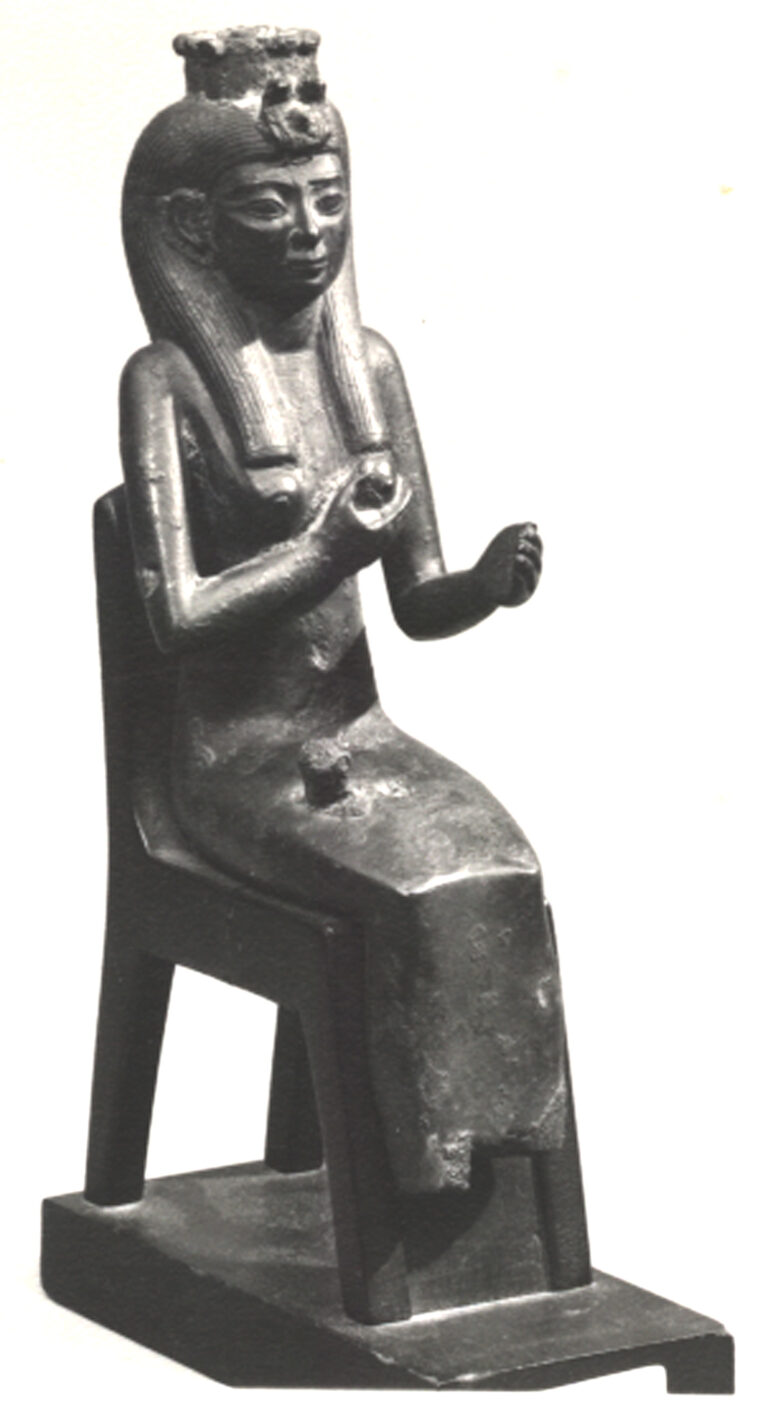
Isis is an Egyptian goddess of protection and powerful magic, closely associated with her husband Osiris and their son Horus. A throne-shaped hieroglyph on her head can identify her, while other images borrow the cow horns and sun disc associated with Hathor. Nursing Horus is one of her best-known visual forms.
In the Osiris narrative, Isis helps restore her murdered husband and protects their vulnerable child from Seth. Winged images express her sheltering power, including protection of the dead. These varied roles make her more than a general mother figure: she is an active guardian whose knowledge and persistence alter the course of the story.
In art and tradition: Throne-sign headdress; Protective wings; Horus on her lap; Horns and sun disc in some images
Worth knowing: Isis can wear attributes shared with Hathor, so inscriptions and context matter.
Read more: The Metropolitan Museum of Art: Isis nursing Horus · Barnes Foundation: Statuette of Isis nursing Horus · British Museum: Ancient Egyptian gods and goddesses · The Metropolitan Museum of Art: The African Origin of Civilization, Isis and Horus entry
Osiris
Ancient Egyptian • the afterlife and regeneration
Osiris is a central Egyptian god of the dead, underworld kingship and renewed life. His close-wrapped, mummy-like body, royal crook and flail, and tall feathered crown are recognisable features. Green colouring in some images connects his renewal with the growth of vegetation rather than describing an ordinary human complexion.
His death at the hands of Seth and restoration through the help of Isis underpin a powerful model of survival beyond death. He also presides over judgement scenes. Numerous small Osiris figures were dedicated in temples, especially in the first millennium BCE, showing how these ideas entered material religious practice as well as myth.
In art and tradition: Mummiform body; Crook and flail; Atef crown; Green skin in some representations
Worth knowing: His imagery concerns regenerated life as well as death and judgement.
Read more: The Metropolitan Museum of Art: Osiris statuette · The Metropolitan Museum of Art: The Art of Ancient Egypt, educator resource · The Metropolitan Museum of Art: Divine Egypt, inside the exhibition · British Museum: Book of the Dead of Hunefer, judgement scene
Horus
Ancient Egyptian • kingship, the sky and protection
Horus is deeply connected with Egyptian kingship and is often shown as a falcon or a falcon-headed man wearing royal crowns. Egyptian traditions include several forms of Horus, so the child of Isis and Osiris should not be treated as the only expression of this ancient deity.
In the succession story, Horus contests Seth’s claim and becomes the rightful heir to Osiris. Images of Isis nursing him emphasise the vulnerable child who will grow into a ruler. The restored Eye of Horus, or wedjat, is another important protective image. Because other gods can also be falcon-headed, a crown or inscription helps establish identity.
In art and tradition: Falcon; Double crown; Wedjat eye; Child’s sidelock in youthful forms
Worth knowing: Several divine forms bear the name Horus, and falcon imagery is shared with other gods.
Read more: University College London: Gods and goddesses in ancient Egyptian belief · The Metropolitan Museum of Art: Divine Egypt, inside the exhibition · The Metropolitan Museum of Art: The African Origin of Civilization, Isis and Horus entry · The Metropolitan Museum of Art: Falcon amulet and identification uncertainty · British Museum: Ancient Egyptian gods and goddesses
Anubis
Ancient Egyptian • embalming and care of the dead
Anubis is an Egyptian protector of the dead and a god of embalming. He can appear as a dark, recumbent canine or as a man with a canine head, conventionally described as jackal-headed. His watchful animal form is especially familiar from funerary objects and tomb settings.
In the Book of the Dead of Hunefer, Anubis leads the deceased towards the balance and attends the weighing of the heart against the feather associated with Maat. This is one role within a scene involving several divine figures: Thoth records the result and Osiris presides. Anubis should therefore not automatically be given every underworld function.
In art and tradition: Jackal-like canine; Canine-headed human form; Funerary shrine; Balance in judgement scenes
Worth knowing: He prepares and guides the dead; Osiris and Thoth have distinct roles in the judgement scene.
Read more: Albany Institute of History & Art: Anubis amulet · British Museum: Book of the Dead of Hunefer, judgement scene
Thoth
Ancient Egyptian • writing, knowledge and reckoning
Thoth is an Egyptian god of writing, learned activity, calculation and recording. He appears as an ibis, an ibis-headed man or a baboon, reminding us that one deity can have several visual expressions. A scribal palette and writing implement suit his role as the divine keeper of records.
In Hunefer’s Book of the Dead, ibis-headed Thoth writes down the outcome of the weighing of the heart. The scene gives knowledge and accurate record-keeping a place in the judgement of a life. His presence is therefore about more than abstract wisdom: it makes writing, observation and the preservation of an authoritative account religiously significant.
In art and tradition: Ibis; Baboon; Scribal palette; Writing implement
Worth knowing: The ibis and baboon are both established forms of the same god.
Read more: The Metropolitan Museum of Art: Striding Thoth · British Museum: Book of the Dead of Hunefer, judgement scene · University of Chicago: Visible Language: Inventions of Writing in the Ancient Middle East and Beyond
Bastet
Ancient Egyptian • protection and fertility
Bastet is an Egyptian protective goddess whose imagery includes both feline-headed human figures and cats. In later statuettes, her cat-headed form often emphasises a more peaceful aspect. She may carry a sistrum, a ritual rattle, along with a basket and a protective, lion-headed aegis.
Her major cult centre was Bubastis in the Nile Delta, although her worship spread more widely. Cat figures and cat mummies were among the objects associated with her cult. Her earlier lion-headed appearances matter too: reducing Bastet to a charming patron of household pets loses the strength and protective force that underlie her religious identity.
In art and tradition: Cat; Cat-headed figure; Sistrum; Lion-headed aegis
Worth knowing: Cat imagery is prominent, but Bastet also had lion-headed forms and formidable protective power.
Read more: The Metropolitan Museum of Art: Cat-headed Bastet · British Museum: The Gayer-Anderson cat
Sekhmet (Sakhmet)
Ancient Egyptian • fierce protection, illness and healing
Sekhmet is an Egyptian goddess whose lioness head and solar disc express dangerous, protective power. She is associated with warfare and destructive illness, but also with healing. Monumental statues from the reign of Amenhotep III preserve her as a formidable seated or standing presence.
Ancient approaches to illness could involve appeasing Sekhmet so that destructive force was restrained. This explains why healing and danger belong within the same divine profile rather than cancelling each other out. An ankh held by the goddess can express the life she grants. These are historical religious ideas, not evidence that modern devotional objects can diagnose or treat disease.
In art and tradition: Lioness head; Solar disc; Ankh; Uraeus
Worth knowing: Ancient healing associations should never be turned into modern medical guarantees.
Read more: The Metropolitan Museum of Art: Statue of Sakhmet · The Metropolitan Museum of Art: The Art of Medicine in Ancient Egypt · Brooklyn Museum: Sakhmet sculpture
Hathor
Ancient Egyptian • music, joy, love and divine nurture
Hathor is an Egyptian goddess associated with music, joy, love and nurturing power. She may appear as a cow, a woman with cow’s horns and a sun disc, or a face with bovine ears. The sistrum, a ritual rattle, is strongly associated with her worship and frequently carries her image.
At Dendera, columns reproduce elements of the Hathor-headed sistrum, bringing the imagery of sacred music into architecture. Such objects show that her attributes belonged to lived ritual settings, not simply to lists of symbols. Her forms and roles overlap with other goddesses, so similar horns or a solar disc alone cannot settle an identification.
In art and tradition: Cow; Cow horns and sun disc; Sistrum; Bovine ears in face-emblems
Worth knowing: Her emblem can form part of a musical instrument or an architectural column.
Read more: The Metropolitan Museum of Art: The Art of Ancient Egypt, educator resource · The Metropolitan Museum of Art: Hathor column and sacred sound · The Metropolitan Museum of Art: Hathor-head sistrum handle · University College London: Gods and goddesses in ancient Egyptian belief
Set (Seth)
Ancient Egyptian • desert, storms and contested power
Set is an Egyptian god associated with desert landscapes, storms, disruptive strength and foreign regions. His most distinctive form has a long muzzle and unusually shaped ears, commonly called the “Seth animal”; identifying it confidently as a single living species is difficult.
In the Osiris cycle, Set kills his brother and contests Horus’s inheritance. Yet he can also defend the solar god against hostile forces, and some Egyptian kings bore names honouring him. A depiction at the temple of Hibis shows him attacking a serpent. These contrasting roles make “god of evil” an inadequate description of his changing place in Egyptian religion.
In art and tradition: Seth animal; Long curved muzzle; Distinctive upright ears; Spear in protective scenes
Worth knowing: His destructive and protective roles coexist; he is not a simple Egyptian equivalent of a devil.
Read more: British Museum: Ancient Egyptian gods and goddesses · The Metropolitan Museum of Art: Seth slaying a serpent at Hibis · The Metropolitan Museum of Art: Divine Egypt, inside the exhibition
Sources & further reading for this section
- University College London: Gods and goddesses in ancient Egyptian belief
- The Metropolitan Museum of Art: Divine Egypt, inside the exhibition
- The Metropolitan Museum of Art: The Art of Ancient Egypt, educator resource
- British Museum: Ancient Egyptian gods and goddesses
- British Museum: Book of the Dead of Hunefer, judgement scene
- The Metropolitan Museum of Art: Re-Harakhty statuette
- The Metropolitan Museum of Art: Stela with an offering to Re-Harakhty
- The Metropolitan Museum of Art: Isis nursing Horus
- Barnes Foundation: Statuette of Isis nursing Horus
- The Metropolitan Museum of Art: The African Origin of Civilization, Isis and Horus entry
- The Metropolitan Museum of Art: Osiris statuette
- The Metropolitan Museum of Art: Falcon amulet and identification uncertainty
- Albany Institute of History & Art: Anubis amulet
- The Metropolitan Museum of Art: Striding Thoth
- University of Chicago: Visible Language: Inventions of Writing in the Ancient Middle East and Beyond
- The Metropolitan Museum of Art: Cat-headed Bastet
- British Museum: The Gayer-Anderson cat
- The Metropolitan Museum of Art: Statue of Sakhmet
- The Metropolitan Museum of Art: The Art of Medicine in Ancient Egypt
- Brooklyn Museum: Sakhmet sculpture
- The Metropolitan Museum of Art: Hathor column and sacred sound
- The Metropolitan Museum of Art: Hathor-head sistrum handle
- The Metropolitan Museum of Art: Seth slaying a serpent at Hibis
04 / Celtic-speaking regions: Irish, Welsh and Gaulish traditions
Celtic-speaking regions: Irish, Welsh and Gaulish traditions
“Celtic” describes a family of languages and related cultures, rather than one uniform ancient religion. Irish and Welsh narratives survive largely in manuscripts written in Christian settings; Gaulish and Romano-British deities are often known through inscriptions and objects. Those different kinds of evidence should remain visible. Several figures below are honoured in contemporary Pagan traditions, but modern devotional associations are not automatically evidence of an ancient, shared Celtic pantheon.
Jump to a profile: Brigid / Brigit · The Morrígan · The Dagda · Lugh · Cernunnos · Rhiannon · Cerridwen / Ceridwen · Epona · Danu: a careful note
Brigid / Brigit
Ireland · poetry, healing and skilled work
The medieval glossary attributed to Cormac describes Brigit as a daughter of the Dagda and a goddess revered by poets. It also names two Brigits associated with healing and smith-work, providing the textual basis for her familiar threefold presentation.
Her story is often discussed alongside Saint Brigid of Kildare. The relationship between the goddess, saint and later customs remains a scholarly debate.
In art and tradition: Poetry and the smith’s craft; the rush cross belongs to Saint Brigid’s traditions.
Worth knowing: Do not present the saint as a conclusively proven disguise for the goddess.
Read more: Carole M. Cusack: Brigit, Goddess, Saint, Holy Woman, and Bone of Contention · National Museum of Ireland: St Brigid’s Day
The Morrígan
Ireland · battle, prophecy and changing form
The Morrígan is a formidable supernatural figure in medieval Irish literature. In the Táin she intervenes against Cú Chulainn, taking the shapes of a heifer, an eel and a wolf. These episodes place her within conflict and the dangerous uncertainty surrounding a warrior’s fate.
Her appearances reward reading individual stories rather than reducing her to a single modern label such as “goddess of death”.
In art and tradition: Animal transformations, cattle and the battlefield.
Worth knowing: Her relationships with other battle figures vary across texts; one fixed triple-goddess scheme can be misleading.
Read more: University College Cork, CELT: Táin Bó Cúalnge, Book of Leinster · Brigid Kathleen Ehrmantraut, University of Cambridge: Interpretatio Hiberniana (2022), p. 39
The Dagda
Ireland · abundance, power and music
The Dagda is a leading figure among the Tuatha Dé Danann in medieval Irish narrative. The Second Battle of Moytura gives him a cauldron that leaves no company unsatisfied and a harp whose music can move listeners to tears, laughter or sleep.
He also appears as a forceful, earthy and sometimes comic character. Abundance and great skill coexist with appetite, conflict and political responsibility.
In art and tradition: Cauldron, harp and enormous club.
Worth knowing: These are narrative attributes, not evidence for a universal set of modern ritual correspondences.
Read more: University College Cork, CELT: The Second Battle of Moytura
Lugh
Ireland · mastery of many arts
Lugh wins entry to the court at Tara by demonstrating that he combines many skills in one person. In the Second Battle of Moytura he organises the Tuatha Dé Danann’s specialists and confronts Balor, making leadership and coordinated expertise central to his story.
His spear is one of the group’s celebrated treasures. His broad abilities are more securely visible in this text than any single modern occupational label.
In art and tradition: Spear and the combined arts of craft, music and warfare.
Worth knowing: Read the Irish Lugh within his own sources before equating him with every similarly named deity.
Read more: University College Cork, CELT: The Second Battle of Moytura
Cernunnos
Gaul · an antlered deity known through objects
Cernunnos is securely named on the Gallo-Roman Pillar of the Boatmen from Paris. Antlers and torcs make this depiction distinctive. Other seated, antlered figures are often compared with him, but not every similar image comes with an identifying inscription.
Archaeology gives us suggestive visual patterns rather than a surviving cycle of stories. Interpretations involving animals, prosperity and abundance should be presented with that limit in view.
In art and tradition: Stag antlers and torcs; related images sometimes include animals.
Worth knowing: Avoid claiming that every ancient horned figure depicts Cernunnos or a single universal Horned God.
Read more: Musée de Cluny: The Ancient Collections · Musée d’Archéologie nationale: Roman Gaul
Rhiannon
Wales · an otherworldly figure of the Mabinogi
Rhiannon’s story appears in the First and Third Branches of the Mabinogi. She chooses Pwyll as her husband, suffers a false accusation after their child disappears, and is eventually vindicated. Later she is caught in the enchantment that falls over Dyfed.
Welsh texts also describe the marvellous singing of her birds. Her name and otherworldly qualities have encouraged scholarly comparisons with an earlier goddess.
In art and tradition: Horses and the wondrous Birds of Rhiannon.
Worth knowing: An earlier divine origin is an interpretation; the surviving narratives do not supply a complete ancient cult.
Read more: National Library of Wales: A Welsh Classical Dictionary, Rhiannon
Cerridwen / Ceridwen
Wales · poetic inspiration and transformation
Ceridwen belongs to Welsh traditions surrounding the poet Taliesin. Earlier poetry connects her cauldron with awen, poetic inspiration. In the later prose tale, a preparation intended to benefit her son instead gives wisdom to Gwion Bach, beginning a pursuit through changing forms.
The earliest surviving full prose version is sixteenth-century, though its poetic connections are older. Both the literary dates and the different spellings matter.
In art and tradition: Cauldron, three drops and changing animal forms.
Worth knowing: Modern goddess devotion should be distinguished from what the surviving Welsh texts directly attest.
Read more: National Library of Wales: A Welsh Classical Dictionary, Ceridwen
Epona
Gaul and the Roman world · horses and abundance
Epona is a Celtic goddess whose worship is documented across parts of the Roman world, including Gaul and Britain. Horses are central to her surviving imagery: she may sit beside them or ride one. A Romano-British bronze in the British Museum places her between two ponies.
Museum interpretation also connects her with the land and harvest. Her widespread material record differs from the manuscript-based evidence for many Irish and Welsh figures.
In art and tradition: Horses, ponies and imagery of abundance.
Worth knowing: Shared horse imagery does not establish that Epona and Rhiannon were simply the same figure.
Read more: British Museum: Epona seated between two ponies · British Museum: Gods and goddesses of Roman Britain
Danu: a careful note
Ireland · an uncertain reconstruction
Danu is widely described today as an ancestral mother associated with the name Tuatha Dé Danann. The historical evidence is much less complete than that confident description suggests. Scholars debate how the name relates to Ana or Anu and to the development of medieval Irish accounts of the gods.
It is therefore better to acknowledge the uncertainty than invent a detailed biography, fixed family tree or ancient list of attributes.
In art and tradition: No securely established, exclusive ancient emblem.
Worth knowing: Modern devotion is meaningful to practitioners; claims about an ancient pan-Celtic mother goddess still need evidence.
Read more: Brigid Kathleen Ehrmantraut, University of Cambridge: Interpretatio Hiberniana (2022), p. 39
Sources & further reading for this section
- University College Cork, CELT: The Second Battle of Moytura
- University College Cork, CELT: Táin Bó Cúalnge, Book of Leinster
- Carole M. Cusack: Brigit, Goddess, Saint, Holy Woman, and Bone of Contention
- National Museum of Ireland: St Brigid’s Day
- Musée de Cluny: The Ancient Collections
- Musée d’Archéologie nationale: Roman Gaul
- National Library of Wales: A Welsh Classical Dictionary, Rhiannon
- National Library of Wales: A Welsh Classical Dictionary, Ceridwen
- British Museum: Epona seated between two ponies
- British Museum: Gods and goddesses of Roman Britain
- Brigid Kathleen Ehrmantraut, University of Cambridge: Interpretatio Hiberniana (2022), p. 39
05 / Mesopotamia: Sumerian, Babylonian and Assyrian traditions
Mesopotamia: Sumerian, Babylonian and Assyrian traditions
Mesopotamian religious traditions developed across many cities and more than three thousand years. Sumerian and Akkadian names sometimes refer to deities who became identified with one another, but local forms, texts and political contexts still differ. A god’s prominence could rise with the fortunes of a city. The profiles below introduce documented roles and imagery without turning ancient temple religions into a modern system of interchangeable correspondences.
Jump to a profile: Inanna / Ishtar · Enki / Ea · Marduk · Ereshkigal
Inanna / Ishtar
Sumerian and Akkadian traditions · love, warfare and Venus
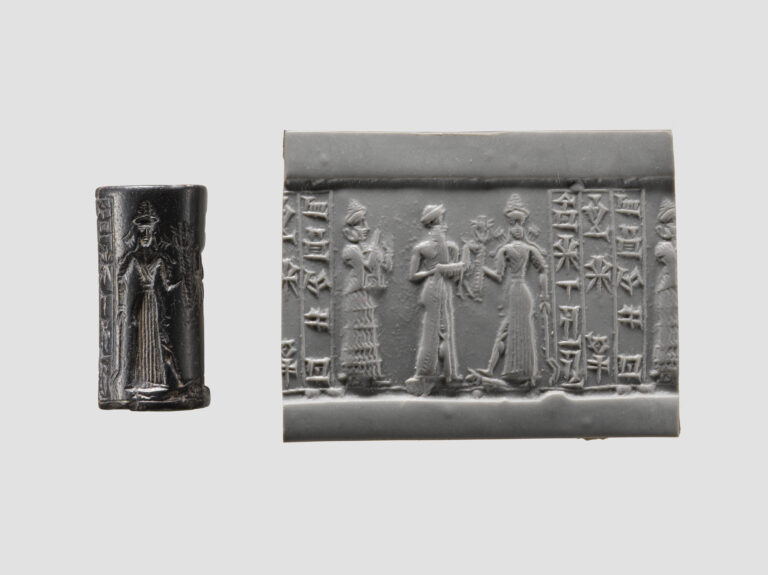
Inanna, commonly identified with Akkadian Ishtar, joins sexual love, warfare and astral power in a complex divine personality. Her celestial association is Venus, visible as the morning or evening star. Her worship had major centres, including Uruk, and developed distinct local expressions.
Images can show an armed goddess with a lion, while the eight-pointed star expresses her astral identity. A nude female figure alone is not sufficient for identification.
In art and tradition: Eight-pointed star, lion and weapons.
Worth knowing: The different names and local manifestations have histories; they should not be flattened into one unchanging character.
Read more: ORACC: Inana/Ištar
Enki / Ea
Sumerian and Akkadian traditions · wisdom and fresh water
Enki, identified with Ea in Akkadian tradition, is closely associated with Eridu and the abzu, the subterranean freshwater realm. He is a source of wisdom and ritual knowledge, especially in traditions concerned with incantation and averting harm.
Ancient images may show water streams containing fish around the god. These recognisable features are more useful for identification than simply calling any aquatic or fish-cloaked figure Enki.
In art and tradition: Flowing water, goat-fish, turtle and ram-headed sceptre.
Worth knowing: Fish-cloaked sages in Assyrian art are not automatically images of Ea himself.
Read more: ORACC: Enki/Ea
Marduk
Babylonia · Babylon’s patron and divine kingship
Marduk rose to exceptional prominence as the patron of Babylon. In the Babylonian poem Enūma eliš, his defeat of Tiamat leads to the gods recognising his leadership; the account also describes the formation of the ordered world.
He was linked with incantation and with the title Bel, “Lord”. His importance belongs to a developing religious and political history, rather than a fixed ranking accepted everywhere in Mesopotamia.
In art and tradition: Triangular spade and the mušḫuššu, or snake-dragon.
Worth knowing: Calling him simply a storm god loses the specific Babylonian evidence and his changing roles.
Read more: ORACC: Marduk
Ereshkigal
Mesopotamia · sovereign of the underworld
Ereshkigal governs the Mesopotamian underworld and appears prominently in stories about Inanna or Ishtar’s descent and in traditions involving Nergal. Her name is usually translated as “Lady of the Great Earth”. Literature supplies much of what is known about her, while evidence for her cult is comparatively limited.
Her identity concerns authority over the dead, not a simple equivalent of a devil or an embodiment of moral evil.
In art and tradition: No securely agreed, exclusive visual emblem survives.
Worth knowing: The “Queen of the Night” relief is not an uncontested portrait of Ereshkigal; its identification remains debated.
Read more: ORACC: Ereškigal
Sources & further reading for this section
06 / Hindu traditions: living paths of devotion
Hindu traditions: living paths of devotion
Hindu traditions encompass many languages, communities, philosophies and forms of worship. Some devotees understand a chosen deity as supreme; others describe multiple divine forms in relation to a single ultimate reality. These brief introductions are educational, not substitutes for practitioners’ knowledge or instructions for adopting a practice. Sacred images deserve respectful presentation, with their region, date and specific form identified wherever possible.
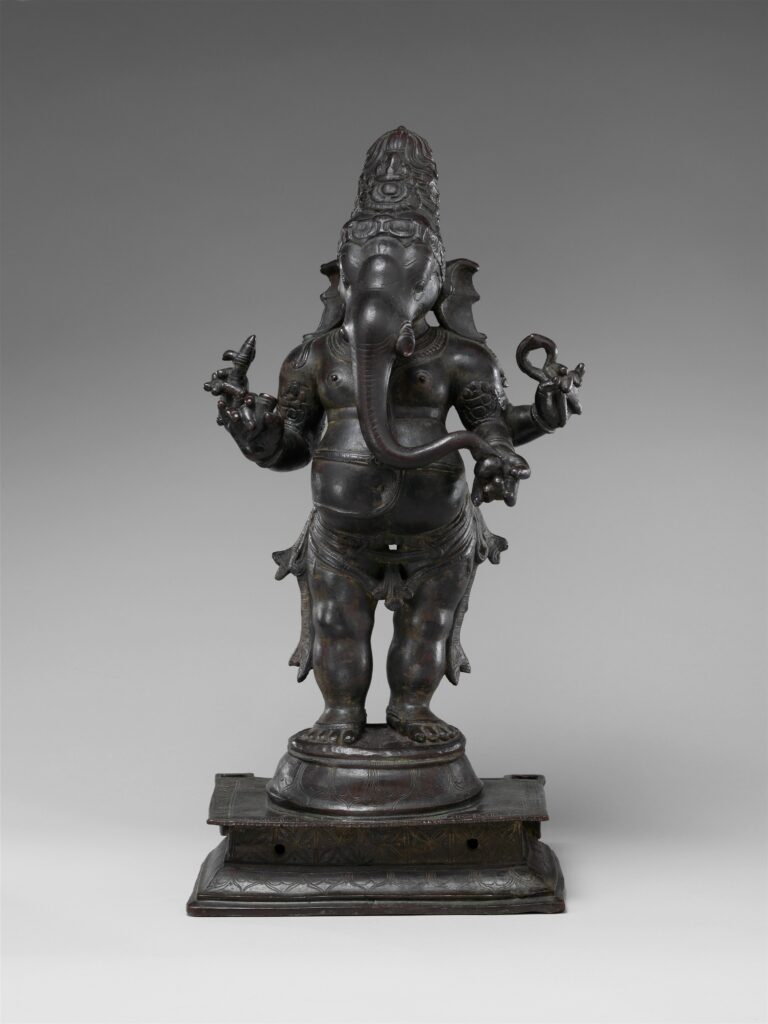
Jump to a profile: Shiva · Vishnu · Devi / Durga · Kali · Lakshmi · Saraswati / Sarasvati · Ganesha
Shiva
Hindu traditions · transformation and divine presence
Shiva is revered in many forms, and for Shaiva communities he can be the supreme divine reality. His image as Nataraja, Lord of Dance, brings creation, preservation and destruction together in one rhythmic composition rather than assigning him only a destructive role.
South Indian Chola bronzes give this form its famous ring of flames. The raised foot offers refuge, while the dance over ignorance communicates liberation.
In art and tradition: In Nataraja imagery: drum, flame, raised foot and encircling fire.
Worth knowing: One sculptural form cannot express the full range of Shiva’s theological and devotional significance.
Read more: The Metropolitan Museum of Art: Shiva as Lord of Dance · Hindu American Foundation: Hindu Concepts About God
Vishnu
Hindu traditions · preservation and the restoration of order
Vishnu is closely associated with sustaining the world and restoring order when it is threatened. Temple sculpture often presents him with the dignity of a sovereign, holding objects that communicate protective power. A monumental Pandyan image at the Met preserves this royal visual language.
Within Vaishnava traditions Vishnu or his forms may be understood as the supreme divine reality. That context matters more than a simplified list of divine jobs.
In art and tradition: Conch, discus, mace and lotus; Garuda is his mount.
Worth knowing: Hindu communities differ in theology and emphasis; a single pantheon diagram cannot represent them all.
Read more: The Metropolitan Museum of Art: Enthroned Vishnu · Hindu American Foundation: Hindu Concepts About God
Devi / Durga
Hindu traditions · the Goddess and protective power
Devi means “goddess” and can designate the divine feminine broadly; Durga is a particular, widely revered manifestation. As Mahishasuramardini she defeats the buffalo demon Mahisha, an image of divine power overcoming a threat to cosmic order.
Sculptures give her multiple arms holding weapons, expressing capacities beyond an ordinary human body. Shakta traditions place the Goddess at the centre of theology and devotion, rather than treating her as a secondary figure.
In art and tradition: Multiple arms, weapons, lion or tiger, and the buffalo demon.
Worth knowing: Devi and Durga are related terms, but they are not interchangeable in every context.
Read more: Cleveland Museum of Art: Durga Destroying the Buffalo Demon · Hindu American Foundation: Short answers to real questions about Hinduism
Kali
Hindu traditions · fierce divinity and Mother
Kali’s striking images can include dark skin, loose hair, a sword and a garland of heads. Such imagery belongs to particular religious and artistic settings and should not be used to portray her devotees as sinister.
She is also approached with profound love as Mother. Ramakrishna’s nineteenth-century devotion at Dakshineswar offers one well-documented example of that intimate relationship, alongside the fierce images familiar from Bengali art.
In art and tradition: Sword, loose hair and fierce imagery; forms and interpretations vary.
Worth knowing: A respectful introduction includes living devotion and avoids reducing Kali to a “goddess of evil” or decorative horror.
Read more: Belur Math: Sri Ramakrishna and devotion to Mother Kali · The Metropolitan Museum of Art: Kali, Bengali chromolithograph
Lakshmi
Hindu traditions · auspiciousness and flourishing
Lakshmi is associated with prosperity, abundance and auspicious well-being. Her significance extends beyond money to the conditions that allow life and households to flourish. Different regions give these ideas distinctive visual expression.
A Bengali print of 1883 shows ripened rice, an owl and shells around her, connecting agricultural plenty with wealth and water. Such details are valuable precisely because they locate the image within a particular place and history.
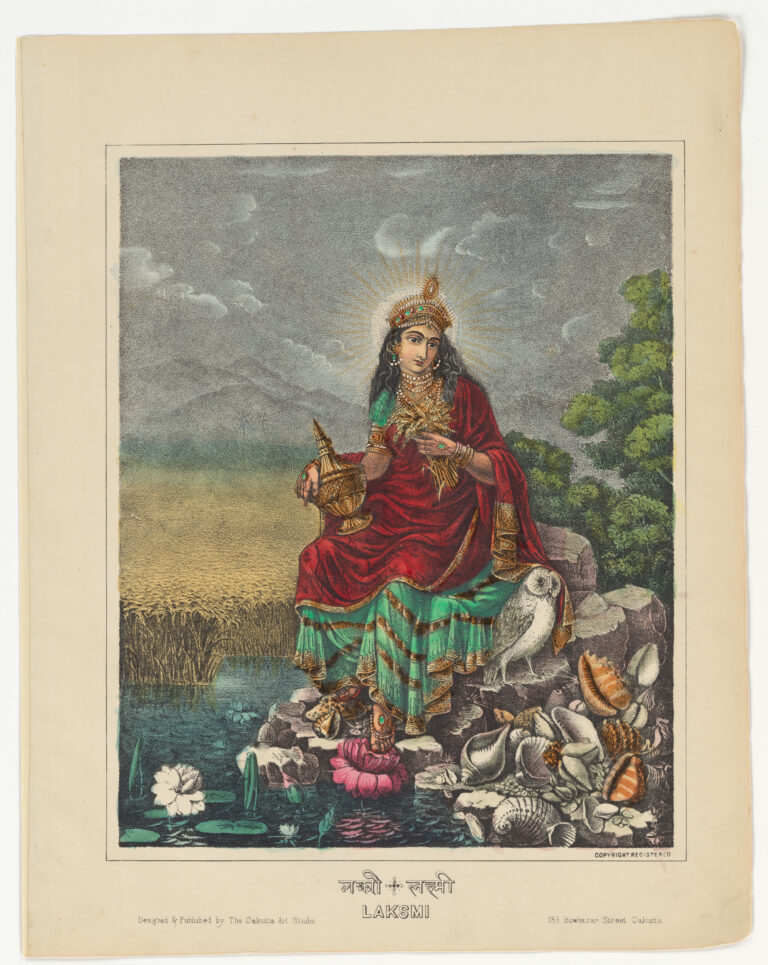
In art and tradition: Lotus imagery is widespread; rice and an owl feature in Bengali representations.
Worth knowing: Do not convert a sacred figure of flourishing into a promise of guaranteed financial gain.
Read more: The Metropolitan Museum of Art: Lakshmi, 1883 · Hindu American Foundation: Short answers to real questions about Hinduism
Saraswati / Sarasvati
Hindu traditions · learning, speech and the arts
Saraswati is revered in relation to knowledge, speech, music and creative learning. Her history includes an early association with a sacred river, while later images often make scholarship and the arts immediately visible through objects she holds.
A vina and books are particularly recognisable in Indian representations. Her transmission into Buddhist settings, including Japanese Benzaiten traditions, also shows how divine figures acquire distinct histories as they cross languages and regions.
In art and tradition: Vina and books; imagery of music and learning.
Worth knowing: Related names across religions do not make their living devotional contexts identical.
Read more: The Metropolitan Museum of Art: Sarasvati · British Museum: Benzaiten (Sarasvati) hanging scroll · Hindu American Foundation: Short answers to real questions about Hinduism
Ganesha
Hindu traditions · beginnings, obstacles and auspiciousness
Elephant-headed Ganesha is widely revered at the beginning of important undertakings and is associated with obstacles and their removal. He is commonly described as the son of Shiva and Parvati. His imagery can be affectionate and approachable while carrying serious devotional meaning.
A twelfth-century Tamil bronze gives him four arms holding a noose, an axe, a sweet and a broken tusk. Regional artworks and narratives present further variations.
In art and tradition: Elephant head, broken tusk, sweets, noose and axe.
Worth knowing: Stories of his head and tusk differ; no one brief version should be presented as universal.
Read more: The Metropolitan Museum of Art: Ganesha, Chola period · Cleveland Museum of Art: Ganesha, 600s
Sources & further reading for this section
- Hindu American Foundation: Short answers to real questions about Hinduism
- Hindu American Foundation: Hindu Concepts About God
- The Metropolitan Museum of Art: Shiva as Lord of Dance
- The Metropolitan Museum of Art: Enthroned Vishnu
- Cleveland Museum of Art: Durga Destroying the Buffalo Demon
- Belur Math: Sri Ramakrishna and devotion to Mother Kali
- The Metropolitan Museum of Art: Kali, Bengali chromolithograph
- The Metropolitan Museum of Art: Lakshmi, 1883
- The Metropolitan Museum of Art: Sarasvati
- British Museum: Benzaiten (Sarasvati) hanging scroll
- The Metropolitan Museum of Art: Ganesha, Chola period
- Cleveland Museum of Art: Ganesha, 600s
07 / Shinto: kami, sacred places and continuing tradition
Shinto: kami, sacred places and continuing tradition
Kami is often translated as “deity”, but the word belongs to a wider Japanese religious vocabulary that also concerns extraordinary presences, places and relationships. Shinto traditions are lived through particular shrines, festivals, households and communities. Historic interaction with Buddhism is important, as are later attempts to separate the traditions. These introductions identify two prominent examples without presenting them as a complete or uniform Japanese pantheon.
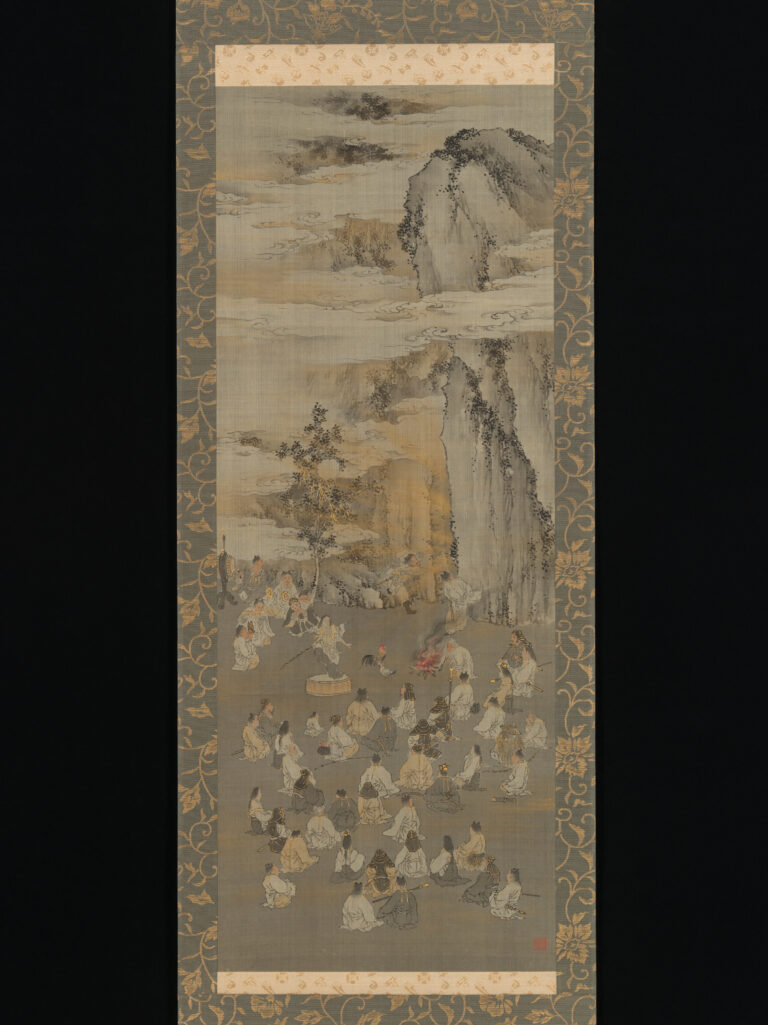
Jump to a profile: Amaterasu-Ōmikami · Inari Ōkami
Amaterasu-Ōmikami
Shinto · the sun kami and Ise Jingu
Amaterasu is the sun kami enshrined at the Inner Shrine of Ise Jingu and is revered in the imperial ancestral tradition. The sacred mirror is central to her representation there.
A famous narrative tells of her withdrawal into a cave and the efforts of other kami to draw her out, returning light to the world. Later artworks interpret that story through the artistic and religious concerns of their own periods.
In art and tradition: The sun, sacred mirror and the heavenly rock-cave narrative.
Worth knowing: Shrine tradition and historical interpretation should be distinguished; Amaterasu is honoured in a living religion.
Read more: Ise Jingu: About Ise Jingu · The Metropolitan Museum of Art: Luring the Sun Goddess Amaterasu Out of a Cave with Music
Inari Ōkami
Shinto · rice, prosperity and diverse local expressions
Inari is associated with abundant harvests and, over time, with business, industry and household well-being. Fushimi Inari Taisha in Kyoto dates its foundation to 711 and is a major centre of this continuing tradition.
Foxes at Inari shrines are understood as divine messengers. The shrine explicitly cautions that this does not mean Inari is a fox. Vermilion gateways express the history of devotion at these places.
In art and tradition: Rice, fox messengers and vermilion torii in shrine settings.
Worth knowing: Inari traditions include varied names and expressions; avoid assigning one universal human appearance or gender.
Read more: Fushimi Inari Taisha: Frequently asked questions · Fushimi Inari Taisha: Official introduction
Sources & further reading for this section
08 / Yoruba and related Afro-Atlantic traditions: orisha
Yoruba and related Afro-Atlantic traditions: orisha
Orisha traditions have roots in Yoruba-speaking West Africa and distinct, living developments across the Atlantic, including Lukumí and Candomblé communities. Forced displacement under slavery and subsequent community histories shaped those developments. Names, stories, associations and religious authority vary by place and lineage. The introductions below offer cultural context rather than initiation advice, private liturgy or a set of deities to detach from their communities.
Jump to a profile: Oshun / Ọ̀ṣun · Shango / Ṣàngó · Yemoja
Oshun / Ọ̀ṣun
Yoruba traditions · river, fertility and community
Oshun is closely identified with the Osun River and the relationship between its waters, fertility and community life. The sacred grove at Osogbo in Nigeria is an active religious place, with shrines and an annual festival sustaining the bond between the deity and the town.
Her importance also continues in Afro-Atlantic religions, where names and emphases have developed within particular communities. Those histories deserve attention alongside popular associations with beauty or love.
In art and tradition: The Osun River and its sacred grove.
Worth knowing: Avoid treating commercial lists of colours, foods or offerings as rules shared by every lineage.
Read more: UNESCO: Osun-Osogbo Sacred Grove · Harvard Pluralism Project: La Regla de Ocha-Ifa and Lukumi
Shango / Ṣàngó
Yoruba traditions · thunder, kingship and justice
Shango is associated with thunder and lightning and with a deified legendary ruler of Oyo. His power includes punishment and protection, so a portrait centred only on anger is incomplete. Museum collections preserve dance staffs made to honour him.
These often show a devotee carrying the double-axe emblem. The human figure on a staff is therefore not necessarily Shango himself, a distinction worth retaining in captions and illustrations.
In art and tradition: Double-headed axe and thunderstones.
Worth knowing: Diasporic names such as Changó and Xangô belong to communities with their own histories and religious forms.
Read more: Smithsonian National Museum of African Art: Staff for Shango · High Museum of Art: Dance Staff for Sango · Harvard Pluralism Project: La Regla de Ocha-Ifa and Lukumi
Yemoja
Yoruba and Afro-Atlantic traditions · water and motherhood
In Yoruba contexts Yemoja is associated with rivers, particularly the Ogun River, and with motherhood and nurturing. In many Afro-Atlantic communities her maritime identity becomes prominent, with names including Yemayá and Iemanjá.
This change is part of a living history shaped by Atlantic displacement and continuing religious creativity. The river and ocean descriptions should therefore be located in their traditions rather than treated as an error to correct or an identical universal account.
In art and tradition: River or ocean imagery, depending on the community and setting.
Worth knowing: Names, relationships and devotional customs vary; learn from the relevant tradition’s practitioners.
Read more: Fowler Museum at UCLA: Yemonja in the Diaspora, with Jahsun Edmonds · Duke University: Yemoja, Goddess of the River Ogun
Sources & further reading for this section
- Harvard Pluralism Project: La Regla de Ocha-Ifa and Lukumi
- UNESCO: Osun-Osogbo Sacred Grove
- Smithsonian National Museum of African Art: Staff for Shango
- High Museum of Art: Dance Staff for Sango
- Fowler Museum at UCLA: Yemonja in the Diaspora, with Jahsun Edmonds
- Duke University: Yemoja, Goddess of the River Ogun
Context matters
Reading with respect
A deity is more than a set of keywords. Start with the language, region, period and community connected to the name. A figure can have different roles in different cities, texts or households, and a later artwork may show a much later interpretation.
- Read the source in context. A poem is not a complete account of everyday worship. Archaeology, inscriptions, temple records and living practitioners offer different kinds of evidence.
- Keep modern practice clearly labelled. Contemporary Paganism includes many approaches, from reconstruction to eclectic spirituality. Personal associations can be meaningful without being ancient or universal.
- Listen to living communities. Hindu, Shinto and Yoruba traditions are living religions with their own teachings and protocols. Some practices involve training, initiation or community guidance; a short online guide cannot provide those.
- Avoid one-size-fits-all correspondences. Colours, plants, crystals and offerings vary by source and community. Similar imagery does not make two deities interchangeable.
- Take your time. Learning about a deity does not require making a devotional commitment or buying anything.
Further context: Harvard’s Pluralism Project: contemporary Pagan traditions.
A few useful distinctions
Common questions
What is the difference between a god and a deity?
“Deity” is a broad word for a divine being. “God” and “goddess” are common English terms, but not every tradition divides the sacred in the same way. Words such as kami and orisha carry meanings that are only partly conveyed by “god”.
Are Greek and Roman deities the same?
They were often identified with one another in antiquity, and many stories travelled between Greek and Roman cultures. But Roman cults, festivals and political roles had their own histories. “Zeus / Jupiter” is a useful comparison, not a claim that every belief or ritual was identical.
Do I need to honour a deity to explore witchcraft?
No single approach is shared by everyone. Some contemporary practitioners are devotional; others use symbolic, nature-focused or non-theistic approaches. This guide supports learning rather than prescribing a spiritual path.
Why do accounts of a deity disagree?
Stories changed across regions and centuries. Some survive only in fragments, inscriptions or later manuscripts. Translators and scholars also disagree. Where the evidence is uncertain, the profiles flag that uncertainty rather than presenting one modern retelling as the only version.
Does an ancient symbol always have the same meaning today?
No. Context changes meaning. An owl in a particular ancient Athenian image may help identify Athena, but seeing an owl today is not historical proof of a divine message. Interpretations of personal experiences belong to individuals and their communities.
Sources & image credits
About this guide
Prepared for Niffty Witchy Supplies, October 2026. The profiles are introductory summaries linked to museum collections, scholarship, historical texts and relevant religious sources. This selection is not an exhaustive survey of world religions and does not imply that every figure is a deity in the same sense.
Illustrations are photographs or reproductions of named historical artworks. Their captions identify the object and museum; an artwork represents its maker’s place and time, not a definitive portrait of a deity. Images supplied through The Metropolitan Museum of Art’s Open Access programme are designated public domain and released under CC0. Read The Met’s Open Access policy.
Descriptions of religious beliefs and traditional roles are educational. They are not promises of supernatural, medical or financial outcomes.